

One of the most common reasons families give up on devotions isn't lack of desire — it's the age gap. You've got a four-year-old who needs everything explained with hand motions, a nine-year-old who wants to go deep, and a thirteen-year-old who would rather be anywhere else. Trying to find one thing that works for all of them at the same time can feel impossible, and so most families quietly decide it's just not the right season.
But some of the most meaningful family devotion times happen precisely because of the age gap, not in spite of it. When a toddler asks an innocent question that nobody in the room can answer, or when a teenager shares something vulnerable in front of their younger siblings, something happens that no age-specific curriculum can manufacture.
So let's talk about how to make it work for everyone in the room — without watering it down for the older kids or losing the younger ones entirely.

Why Mixed-Age Devotions Are Actually a Gift
Before we get into the practical side, it's worth reframing the challenge. A room full of kids at different developmental stages isn't a problem to solve; it's actually one of the most powerful environments for faith formation. Younger children learn by watching their older siblings engage seriously with Scripture. Older kids are quietly shaped by having to explain things simply, which deepens their own understanding. And all of them are watching you, the parent, hold it all together with patience and genuine faith. The mixed-age family devotion time isn't the lesser version of the thing. In many ways, it's the richer one because it reflects real life, where faith doesn't happen in age-sorted groups but around shared tables with people at every stage of the journey.
The Secret Is a Shared Anchor With Room to Go Deeper
The key to making mixed-age devotions work is choosing one central truth or passage that everyone can access at their own level, and then letting the conversation naturally go as deep as the older kids need it to. You're not trying to teach the same lesson four different ways. You're starting from the same place and letting each child engage with it according to where they are. Here's what that looks like in practice:
Read the same passage together — even if the younger children don't understand every word, hearing Scripture read aloud as a family has value in itself
Ask one simple question first — something even a young child can answer, like "what did you notice in that story?" or "what word stood out to you?"
Then go deeper — follow up with a question that invites older kids to think more critically, like "why do you think God responded that way?" or "what does this mean for how we live?"
Let the younger kids anchor the prayer — toddlers and young children can say thank you prayers or repeat short phrases, while older kids and parents pray more freely around them
This approach means nobody is waiting for the others to catch up; everyone is engaging at their own level with the same shared moment.
Age-by-Age Tips for Keeping Everyone Engaged
Here's a quick reference for what tends to work at each stage, so you can think through your own family as you read:
Under 3 — keep them close, let them hold something (a small cross, a children's Bible, a candle to watch), and don't worry about whether they're "getting it." They're absorbing the atmosphere of faith more than you realise.
Ages 3–6 — simple retellings of Bible stories, fill-in-the-blank prayers, and anything with movement or a physical object to hold their attention. Ask them, "What do you think?" and take their answers seriously.
Ages 7–11 — this is the golden age for family devotions. Kids this age love discussion, are genuinely curious about God, and are old enough to have real opinions. Give them a job like reading the passage, leading the prayer, or writing down the prayer requests.
Ages 12+ — teenagers need to feel respected, not talked at. Ask genuine questions and be willing to sit with the hard ones. Let them push back. Let them lead. The goal at this stage isn't compliance, it's honest engagement with faith on their own terms, in a safe space you've created together.
What to Do When the Teenager Checks Out
It's going to happen. And when it does, the worst thing you can do is make it a bigger deal than it needs to be. A teenager who sits quietly through family devotions and seems disengaged is still present. They're still hearing and watching you model what it looks like to take faith seriously as an adult. Keep showing up, making space for them, and resist the urge to call them out in front of their younger siblings. Privately, let them know their thoughts matter to you. Ask what they'd want to talk about or pray for. Give them ownership wherever they'll take it. The season of visible disengagement is usually temporary, and what you're building underneath it is not.
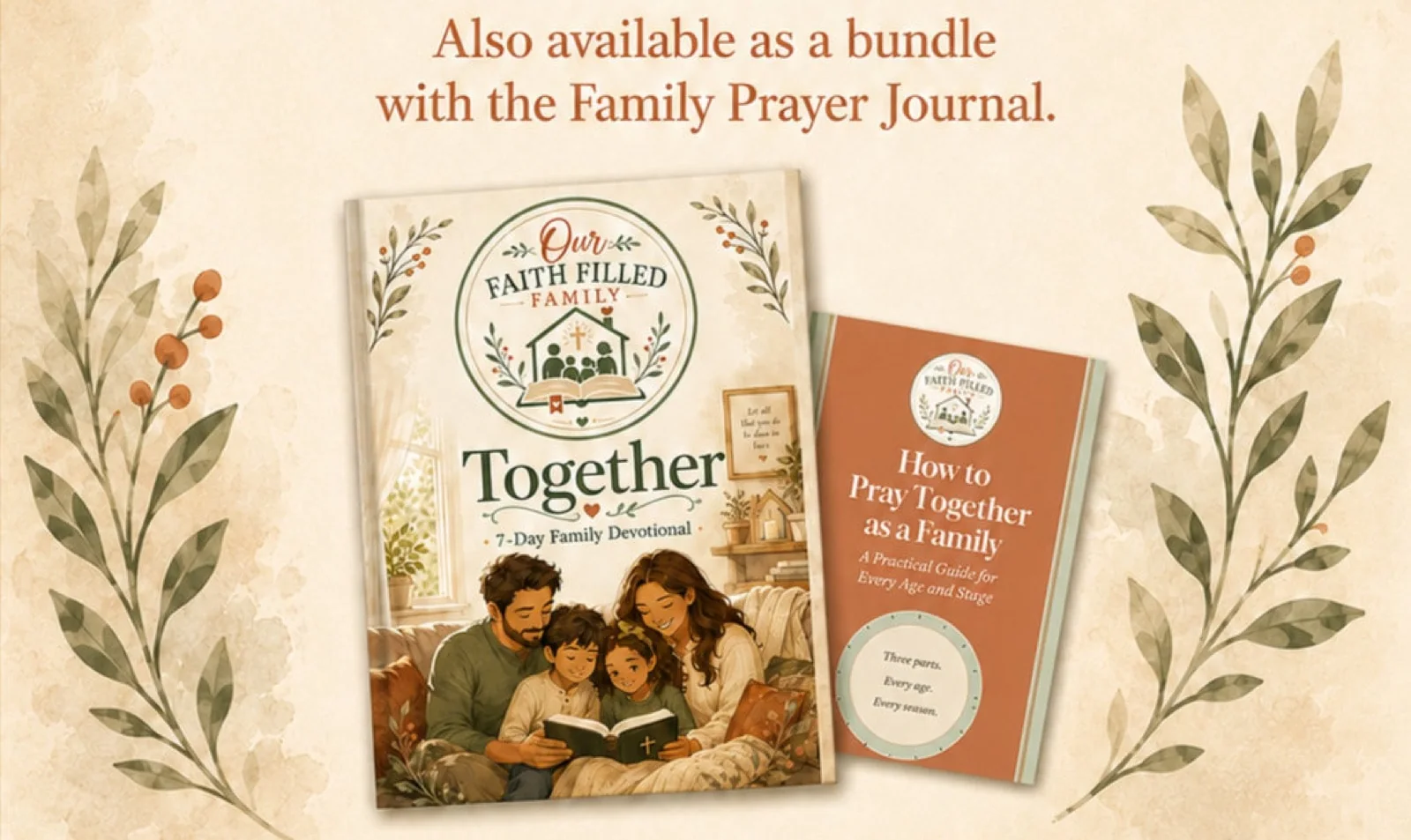
If you're looking for a devotional that works for a mixed-age family without requiring you to prep four different versions of the same lesson, Together: A 7-Day Family Devotional Vol. 1 was built with exactly this in mind. Each day gives your whole family a shared starting point — the Scripture, reflection, and questions — and the conversation naturally meets each child where they are. It's short enough that even the youngest kids can stay engaged from start to finish, and deep enough that your older kids and teenagers have something real to hold onto.
And if you want to go further, the Together Vol. 1 + Family Prayer Journal bundle gives your family both the devotional and a beautiful space to record what God is doing in your home as you go through it together. When you purchase both together, you'll automatically receive 5% off.
Your Family Doesn't Have to Be Simple to Do This Well
The complicated, loud, beautifully messy mixed-age family is not the obstacle to a meaningful devotional life. It's the context for one. The questions your kids ask each other, the way your teenager sometimes softens when a younger sibling says something unexpectedly wise, the moment when everyone laughs at something in the middle of a serious passage, that's not a distraction from the point. That is the point. Faith lived together, in all its imperfect and wonderful complexity.
Start where you are. Bring all of them. Let God do the rest.
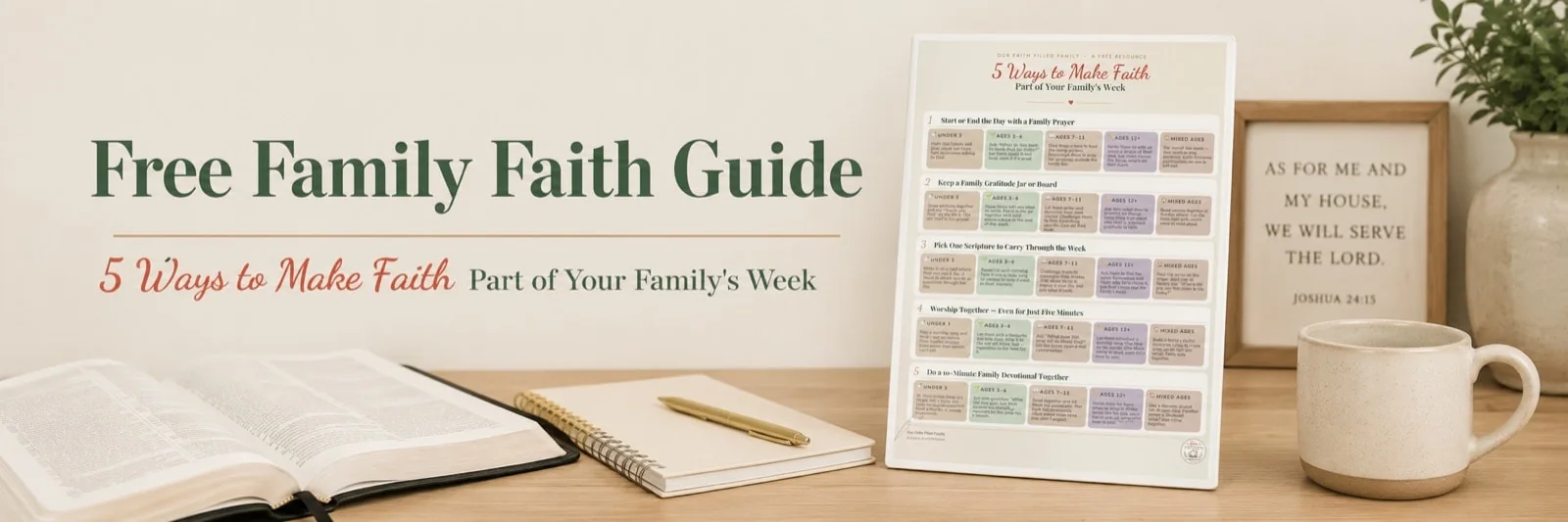
Want simple, practical ways to bring faith into your family's everyday life? Subscribe to our mailing list, and you'll get instant access to our free guide — 5 Ways to Make Faith Part of Your Family's Week — plus subscriber-only discounts, first access to new releases, faith-filled tools and resources, encouragement and Scripture for your family, behind-the-scenes peeks at what's coming, and simple prompts to help you stay intentional in your home. Everything you need to keep showing up for your family, straight to your inbox.